


Somewhere near you, right now, four adults are shouting "the key is in the fish!" They paid roughly the price of a cinema ticket each to be locked in a room decorated as a submarine, a bank vault or a serial killer's basement, and they will leave in an hour feeling closer to each other than a dinner would have made them. That is the whole product. It has no plot to spoil and no screen to look at, and for a decade it has been one of the fastest-growing things you can do with your friends.
A decade in three numbers
The people who track this most carefully are the reviewers at Room Escape Artist, who count every facility in the United States each December. Their December 2025 report puts the count at just over 2,000 facilities, each holding an average of 3.8 games — around 7,800 rooms to play. In 2014 there were about 24. The years in between read like a fever chart: 317% growth in 2015, 800% in 2016, then a slow settle to 2% by 2019, a 4.3% drop in the first half of 2020 and another 7.5% by early 2021, and then — nothing. The count has been flat for three straight years. "Stable, but shifting," the report says: ownership is consolidating, and operators are adding challenge arcades and overnight experiences next to the rooms.
Money tells the same story from another angle. IBISWorld sizes the US escape-room business at $654 million in 2024, down 1.2% that year and shrinking about 6% a year since 2019. The global estimates are rosier and wildly inconsistent — one research house puts the world market at $6.7 billion in 2025 growing toward $13.7 billion by 2032, another starts at $12.7 billion — but they agree on the direction: the physical room has matured in its home market, and the growth is elsewhere.
Where the growth went
"Elsewhere" has an address: your video call. When the rooms closed in 2020, the bigger operators put a camera on a game guide inside the physical room and let teams on a video call steer him — "left, no, left, open the drawer" — while a web dashboard showed the clues. The Escape Game still sells exactly that, at $30–35 a player for an hour with up to ten people, and lists Google, Apple and LinkedIn among the companies that book it for team building. A whole second tier grew around it: browser-based rooms with a live host on a video call at $25–37 a head; self-guided two-player puzzles, where each player sees half the room and must talk to the other, from a few dollars; corporate packages that run twenty people through breakout rooms for $750–1,500 an event.
What the remote room lost in padlocks it gained in reach. A physical room needs everyone in the same city on the same evening. A remote one takes a grandmother in Lyon, a son in Montréal and two grandchildren in Lisbon and puts them in the same submarine. For families that live apart — which is most families — that is not a downgrade. It is the only version that was ever going to happen.
The strange thing about the themes
Look at the catalogue of any operator and count the moods. Prison break. The heist. The depths. Zombie apocalypse. A haunted asylum, a serial killer, a bomb with a timer. The escape room, an activity people book for birthdays and office parties, is overwhelmingly built on dread. There is a good design reason for it: fear is an easy way to make a clock feel real. But it is odd that the second most reliable way to make a group of people feel close — making each other laugh — is almost absent from a business whose entire value is making a group of people feel close.
The exception proves the point. The few "comedy" rooms on the market are workplace satire — you escape a meeting, a corporate retreat, an HR training. The joke is on the office. It is never on you, in the affectionate sense: your family's running gags, your grandmother's famous bakery story, the thing your brother says every Christmas. Nobody builds the room around the people in it, because until recently nobody could.
What we built
We can, because that is the only thing MYJOKES.AI does: it learns what makes one particular person laugh and makes jokes for them — as text, pictures and video, in ten languages. So we built an escape room where the key is a laugh: The Great Joke Vault Escape. Your host is AIC (Assisted Intelligent Comedy). He opens a video call, is there first, and runs the whole experience from inside it: the story, every door, the hints and the countdown. Everyone joins the call and opens their own private page on a PC, a Mac or a phone — your half of a clue, your answer box, your camera and microphone. Nothing to install, nothing to approve.



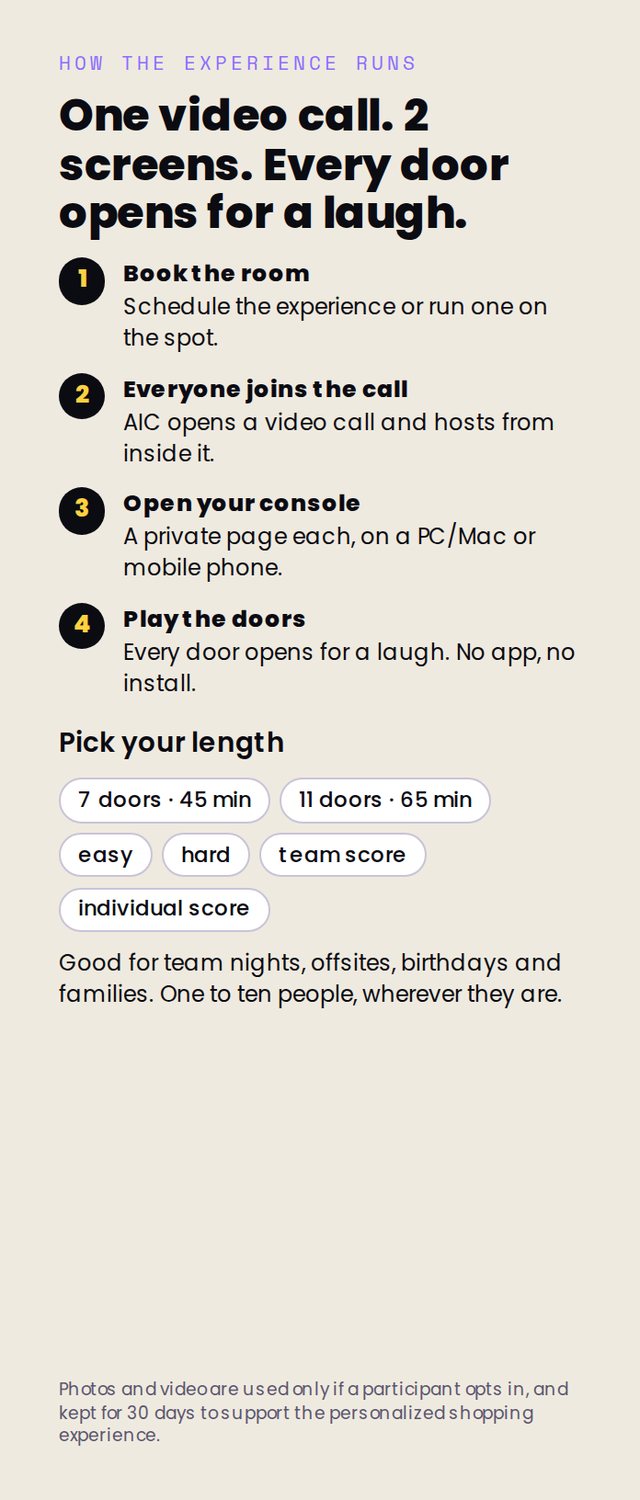
You are locked in the back room of a comedy club, and there are two versions of the experience: seven doors in 45 minutes, or eleven doors in up to 65 minutes, for one to ten people, as a team or each for yourself. Every door opens for a laugh:
The coat check has three padlocks, and every clue is cut in half across your phones. The green room asks you to write a funnier punchline than AIC’s, and the room votes for a favourite. Caption this shows a picture with no caption, and you beat the AI’s line. The goofy face wall is sealed once everyone has pulled their worst, and then the room votes. The stage gives each of you forty-five seconds of stand-up, with stars from the room and a score from the judge.
The long version adds the brain teasers: an anagram lock of five shuffled comedy words, where what one person types everyone sees; a writers’ room where a mini-sudoku and a quiz are filled in together, keystroke by keystroke; the mirror, three comics drawn and warped out of shape that you have to name; guess who, the same faces thirty-five years older or twenty-five years younger; the echo room, three lines said back to front that you put right; and tomato rain, where tomatoes fall and your camera tracks your head so you can duck — or you use a mouse or a finger. Then the key opens itself once the ranking is in, and you are out. The winning face is drawn as a caricature you can put on a mug, a tee or a cap, and you can personalize the goodies from your group photo.
It is open now, and priced like a family game night, not a corporate off-site: from $9 per participant, $7.20 from four. Click the brochure above to flip through it or download it, or go to escaperoom.myjokes.ai — and if you run a team and want to trade a haunted asylum for an evening where people laugh at each other on purpose, write to us: funny@myjokes.ai.
Every escape room is really a machine for making a group of people talk to each other. We would just like the talking to end in a laugh.